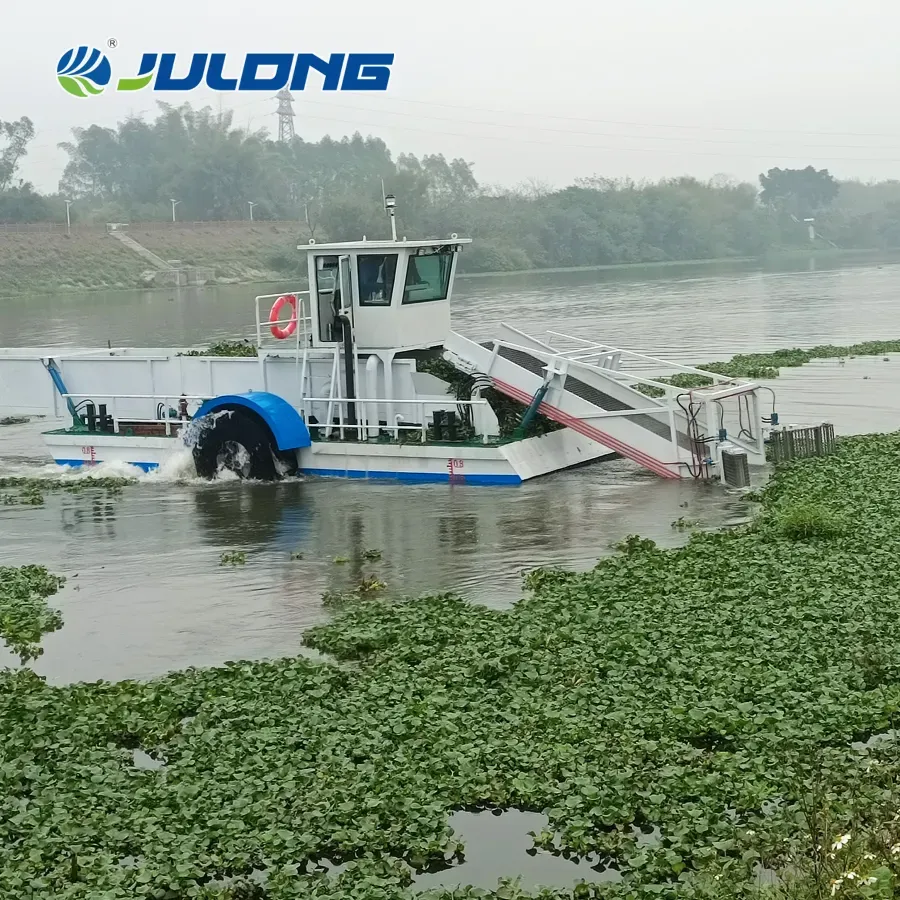
In solving the problem of aquatic weed infestation in water bodies, where manual work is involved or alternative options such as mechanical use of weed cutting boats such as JULONG, there is a lot of difference that can be made. Manual process depends on time-consuming tools, whereas JULONG high tech equipment’s provide accuracy, scalability, environmentally friendly, and suitable in line with the present necessity of water management.
Efficiency and Automation
Manual seed plucking is labor intensive using equipment such as rakes or sickles, whose work range is low and it consumes a lot of time. JULONG, as a contrast, automates the entire process by having submerged cutters with the purpose to attack the roots of weeds, and conveyor belts to accumulate and convey the waste. This removes the human factor of wear and tear, and allows the process to run continuously, without needing people to work to get the desired results in hours as opposed to days where a human being does the manual work. An example is the ability of the boats to cut through dense water hyacinth despite maneuvering through narrow channels resulting in level coverage of the boat body.
Environmental Stewardship
Although manual procedures do not use machinery, they are associated with the disturbance of habitats in terms of multiple disturbance of the sediment and the unintentional harm of the local species. The boats produced by JULONG focus on ecological stability: The hydraulic systems ensure that there is less oil leakage, and the low noise engines do not affect the wildlife so much. Also, their submerged cutting equipment is developed to remove invasive species rather than use the techniques that include pulling out beneficial plants without altering the natural habitats. As an illustration, in cities, these vessels are used in the maintenance of scenic river environments as these kinds of boats hold the debris in enclosed cabins until it is collected.
Adaptability to Complex Environments
The manual teams cannot cope with the difficult terrains such as the shallow marshes or the deep lakes with an uneven bottom. The boats manufactured by JULONG are multifunctional: the paddle-wheel drive and variable depths of cutter (up to 1.3 meters) enable them to work both in shallow wetlands and open waterway conditions. They also are used to easily dismantle and transport them to remote places hence accessibility even in the infrastructurally deprived places. This versatility suits them in many environments, including reservoirs and coastal areas.
Cost and Safety
Manual removal leads to continuous labor expenses and poses chances of injuring a worker because of water-borne hazards. The boats produced by JULONG may need a preliminary investment, but, due to low-maintenance and efficiency rate in the fuel consumption, they save costs in the long-term perspective. The whole process is managed in a safe cabin and operators do not experience physical tension and safety hazard.
Conclusion
Mechanical weed cutting boats provided by JULONG can transform the whole aquatic management with its automation, environmental consideration, and affordability. They do not only provide scalable solutions to large-scale projects compared to the manual methods but also conserve ecosystems. In eliminating invasive weeds in lakes or ensuring navigable rivers, JULONG has developed technology that provides a lasting cost-effective alternative that can be in line with ecological water conservation principles of today. These vessels pave the way in terms of future maintenance of the water bodies by keenly focusing on innovation and environmental friendliness.

